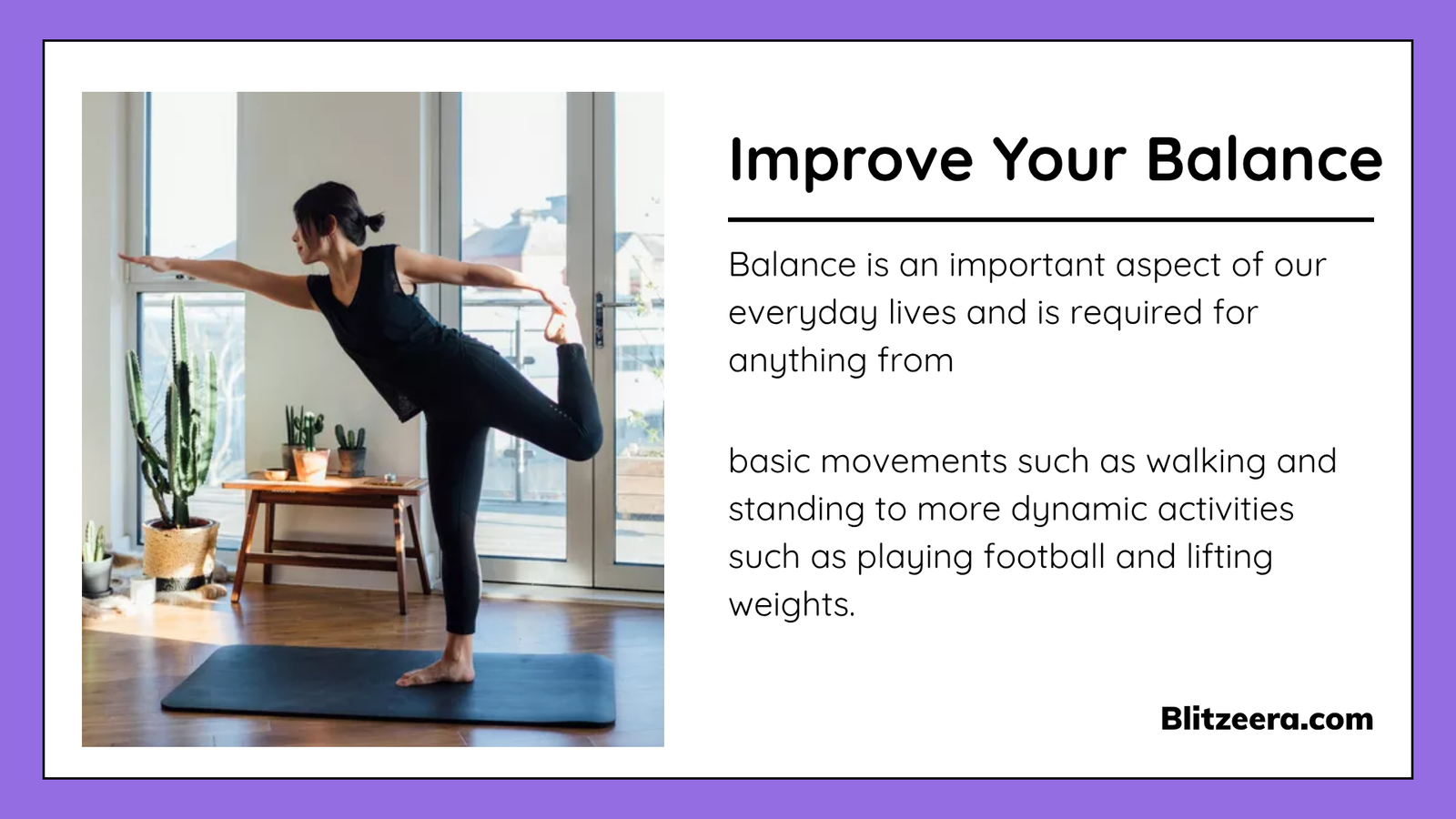
9 Ways to Improve Your Balance: Balance is an important aspect of our everyday lives and is required for anything from basic movements such as walking and standing to more dynamic activities such as playing football and lifting weights. It’s the invisible glue that ties all movement together. It lets you move around your environment yet remain steady.
Balance is a complex system that integrates vision, proprioception (awareness of your body) and the vestibular system (inner ear) to prevent you from falling over. It also involves how your body reacts to movement, adjusts to different surfaces, and rebounds from disruptions to your equilibrium, such as tripping or stumbling.
Poor balance increases the likelihood of falls, the greatest cause of fatal and non-fatal injuries for older Americans, according to the National Council on Ageing. A poor sense of balance can lead to sports injuries and general physical underperformance, even in younger people. Part of improving balance is preserving excellent health and longevity for healthy, active ageing and a pleasurable life.
9 Ways to Improve Your Balance
Understanding Balance
Balance is a complicated process that involves the coordinated activity of three components: proprioception, vision, and the vestibular system.
- Proprioception or body awareness is the perception of self-movement and the location of the body. It is the capacity to feel the position, location, direction, and movement of the body and its parts. This ability is needed for equilibrium. It lets you know where your body is in space at any given time.
- “Proprioception is primarily the result of receptors in your muscles and joints sending information to your brain about your body’s position and movement,” says Seth Forman, M.Ed., Athletic & Sports Performance Trainer, CSCS, and head of education and training for the Kayezen VECTOR System.
- Vision is your brain’s primary source of information about your world. It allows you to see, assess distances, and sense motion, all of which help you maintain your balance. Your eyes are always looking around and sending information to your brain about changes in your environment,’ says Dr Caryn McAllister, PT, DPT, CEO of High Quality Home Therapy in Stamford, Connecticut.
This system permits us to change our movement based on the directions and foresee which way we will travel so our muscles can respond correctly to smoothly maintain balance,” she explains.
The vestibular system is in the inner ear and is important for your balance because it tells your brain about the position and movement of your head and whether you are moving up and down or forward at a slow or fast rate, according to Dr Debbie Dy, Doctor of Physical Therapy and Orthopaedic Clinical Specialist at Fusion Wellness & Physical Therapy in Los Angeles, CA. It works with our eyesight and proprioception to help us stay steady and maintain balance.
These three systems, proprioception, vision, and the vestibular system, work together to preserve balance. These systems provide the brain with sensory information that it constantly processes to trigger the right reactions in your muscles and joints, helping you stay stable and in equilibrium, Dr McAllister adds. “The muscles contract and relax to prevent the body from falling in response to the incoming sensory input,” she explains.
But several factors may influence equilibrium. For example, age-related changes might reduce various systems, disrupting equilibrium. Other factors, such as certain drugs, health problems, or insufficient physical exercise, can also affect balance.
“It’s vital to know these variables and do all you can to minimise their effects, such as exercising regularly and being in excellent health overall,” adds Dr Dy.
Research has shown that exercise programmes can reduce falls that cause injuries by 37%, serious injuries by 43%, and broken bones by 61%.
Simple Strategies for Better Balance
There are a few techniques to enhance balance, including focusing on mobility and strength to improve posture and core engagement, practicing mindful movement, and adding single-leg workouts to your regimen.
Focus on Posture
Good posture builds equilibrium. It provides a solid foundation and positions the body in the most stable way. Forman believes that if you have inadequate mobility, you will struggle to maintain the proper posture needed to keep your balance.
Keeping a neutral spine, with your head over your shoulders and your shoulders over your hips, may do a lot for your balance. Building in a regular mobility programme may be quite helpful to offset what repeated movements like sitting, computer or desk work, or texting can do to your spinal posture,’ explains Dr Dy.
Strengthen Core Muscles
Dr Dy says that the core muscles provide whole-body stability and support. “A strong core is important for balance; it allows us to shift our weight from one leg to the other and walk on uneven surfaces.” Core-strengthening activities like planks, bridges, and abdominal curls can help improve your balance by increasing your body’s stability and control.
Learning how to activate your core properly will also help you retain your balance. Your core comprises your back, abdominals, and glutes. A strong, steady core can help you stay upright when you encounter a balancing difficulty, such as uneven terrain or stumbles. Engaging your core will help you do that.
Mindful Movement
“Mindful movement is about paying attention to your body or checking in with it as you move,” explains Dr. McAllister. Incorporating mindfulness into daily activities can significantly enhance body awareness and, in turn, improve balance. She proposes a physical activity “diet” in which individuals take “movement snacks” or brief bursts of exercise distributed throughout the day, making it easier to incorporate mindful movement activities.
Mindful movement is about being present in your body and noticing what it feels like to move. Practices such as Qi Gong, Tai Chi, and yoga, which emphasise the body-mind link, can help enhance balance, flexibility, strength, and mental health, Dr. McAllister says.
For example, exercises on a trampoline or rebounder can help increase proprioception, as can activities that blend footwork and balance with eye-hand coordination — like striking a ball with a pickleball paddle.
Single-Leg Exercises
Single-leg exercises are a terrific technique to test and improve balance. Exercises like standing on one leg, leg lifts, and lunges can help build the muscles needed for balance, improve proprioception, and enhance stability.
To get the best results, add these exercises to your normal training plan. You may also add weights, such as dumbbells or a medicine ball, to make each motion harder.
“It’s the consistency of practising that leads to the brain and body adapting and getting better at it, and then your balance improves over time,” Dr McAllister explains. “The key is to incorporate balance exercises into your daily routine regularly.”
Balance-Boosting Forms of Exercise
Other kinds of exercise to improve balance include tai chi, yoga, and utilising a wobble cushion or balance board.
The best workout for someone is the one they enjoy; thus, preference should always be given first. “Nobody should do what doesn’t feel good, so it’s important that your body loves the activity you choose,” Dr McAllister adds.
Tai Chi
Tai Chi is a type of exercise that offers benefits in balance, flexibility, and mindfulness. The ancient Chinese martial art consists of slow, deliberate movements, deep breathing, and mindfulness of the present moment. “Tai Chi’s slow, controlled footwork requires strength and good sensory input,” says Dr McAllister, “and it automatically shifts your weight back and forth, letting your body get used to balancing in different positions.
Tai Chi is soft and does not involve forceful motions; therefore, we tend to notice fewer injuries in our adult patients who practice it. “Tai Chi is easily adaptable, so it can benefit people recovering from surgeries or who can’t stand for long periods,” she explains. Research shows that Tai Chi can reduce the risk of falls among older adults by up to 50%. It is a powerful tool for improving balance and overall health.
Yoga
Yoga is a wonderful practice for increasing balance and core strength. Balance is the main focus of yoga positions such as Tree Pose, Warrior III, and Half Moon Pose, which challenge your stability and strengthen your core.
Yoga also promotes body awareness, which is important for balance, Dr Dy explains, because it encourages mindfulness and attention to the body’s motions and sensations. “Improving body awareness is a good place to start to strengthen the sensory systems involved with balance,” she says. Regular yoga practice may lead to profound gains in balance, flexibility, and strength.
Balance Boards and Wobble Cushions
Balance boards and wobble cushions are excellent tools for testing and developing balance, as they provide an unstable surface that forces you to activate your core muscles and use your sense of balance to remain upright. They can assist in strengthening the muscles needed for balance, they can increase proprioception, and they can improve stability,” Dr Dy says.
“Exercises on unstable surfaces can be very beneficial to prepare our body and nervous system to navigate in the real world, as we know that walking surfaces are not always flat and smooth,” adds Dr Dy, who suggests Airex pads. “Doing balance exercises on the soft foam allows you to rely more on the proprioceptive input from your feet and ankles,” she says. Another excellent choice is exercise balls, especially because you may use them for stretches.
Other Considerations
Other elements such as footwear, eyesight, and hydration also affect balance.
Footwear
The shoes you wear may greatly impact how you stand. Good support and traction in shoes help to provide a sturdy platform. “You need proper arch support for balance,” adds Dr McAllister, “and a wide enough toe box so you don’t squish your toes. The soles should grip and not slip, and if you don’t wear flat shoes, choose a low, broad heel.
And laces that tie nicely and don’t come undone quickly. When you’re doing weight-bearing activities such as strength training, you should use weightlifting shoes to help you stabilise and brace correctly, maintaining optimal form. “Proper shoes can help you maintain your balance and help you avoid slips and falls,” Dr McAllister says.
What to Look for in Footwear for Balance
-
Proper arch support
-
The toe box should be wide enough so that your toes are not squished, as you need them for proper balance.
-
Soles that grip surfaces well and don’t slip.
-
A low wide heel if not wearing flat shoes
-
Laces that tie will and don’t come undone easily
Vision Check-ups
Your balance, according to Dr Dy, depends on information from your body and the environment, conveyed through your eyes, proprioception, and vestibular senses, to maintain your equilibrium. “When you’re missing one of these systems, your body has to compensate and rely more on the other two.
This can create balance problems and increase your risk of falls,” she says. Regular eye exams can help detect and treat vision problems early before they affect your balance, especially as you age.
Get at least one test every 24 months for those aged 18 to 64, Dr McAllister advises. After 64, the general guideline is to get a test at least every 1-2 years; however, others require it more regularly owing to visual problems.
Hydration
Staying hydrated is key to keeping those muscles working and balanced. “If you’re dehydrated, it’s common to get dizzy, and occasionally that can happen because of low blood pressure,” Dr Dy explains. It can also cause the vestibular system to shift with dehydration, she continues, because the canals in the inner ear that give input to where your head is in space are filled with fluid. These sensory receptors can be off if the level of this fluid is unstable. This might lead to dizziness or vertigo.
Tips to help improve balance are:
excellent posture, strengthening core muscles, mindful movement, and single-leg exercises. Exercises like Tai Chi, yoga, and balance boards can help improve your balance. Make sure you wear the right shoes, keep up with regular eye exams, and stay hydrated. A more balanced life can be a safer, more confident, and happier existence. Try these tactics and exercises to improve your balance and general health for years to come.